Journal
Chinese Healthy Habits: A Day of Everyday Rituals
From warm water at dawn to a foot bath at night, everyday Chinese rituals reflect climate, work rhythms, family habits, and the practical comforts of home.
There is no single Chinese daily routine. Still, certain gestures recur often enough to be recognizable: a warm drink on waking, a pause after lunch, an unhurried walk after dinner. Their meaning lies less in promises about the body than in how ordinary days are organized.
Warm Water on Waking
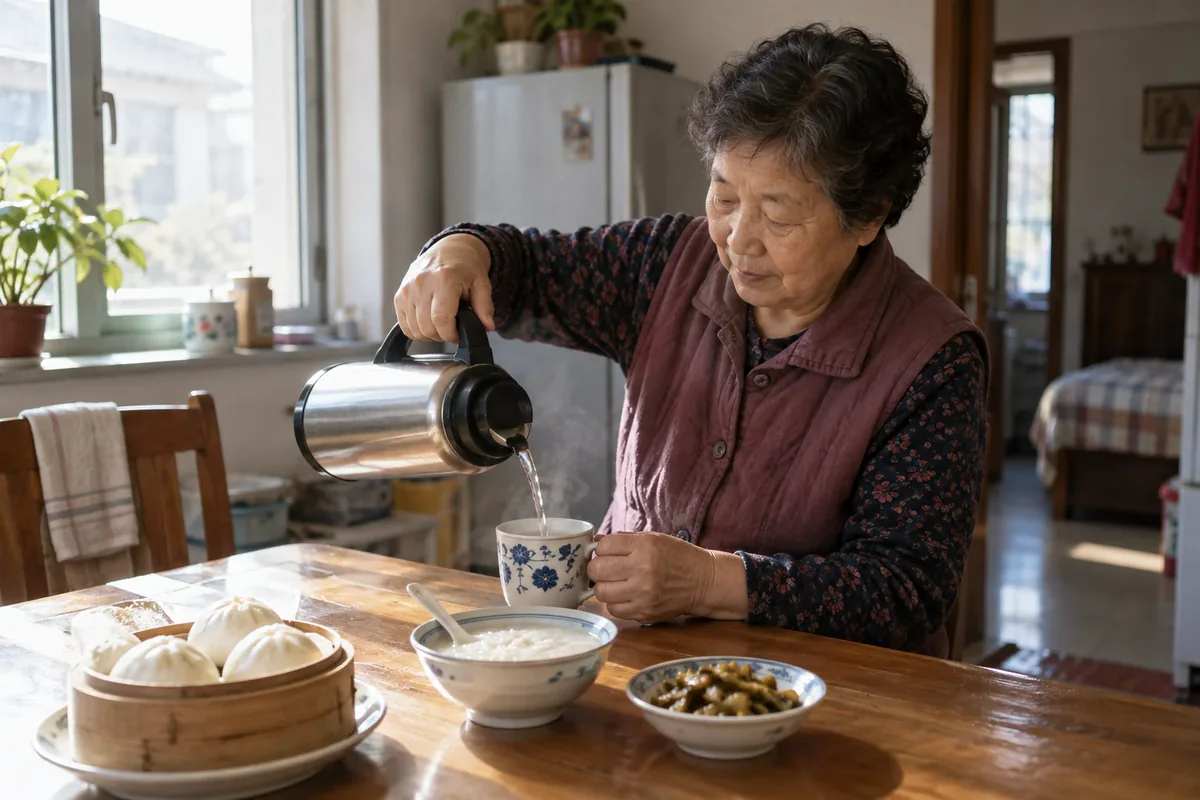
In some homes, the first drink of the day comes from a thermos filled the night before or from a kettle boiled that morning. It may be plain water rather than tea. The action is small enough to fit between opening the curtains and making breakfast, and family members often learn it simply by copying one another.
The habit has a practical history. Fuel was once costly, refrigeration was limited, and households could not assume that tap water was ready to drink. Boiling, storing, and pouring water became linked with responsible housekeeping. Twentieth-century public campaigns reinforced boiled water, while offices, schools, stations, and trains made hot water easy to obtain.
There is also an older cultural vocabulary of warming and cooling. Within that vocabulary, beginning with something warm feels moderate and familiar. It is a way of describing preference and balance, not evidence of a clinical effect. Younger people may choose iced coffee instead; the thermos is common, not compulsory.
A Breakfast That Arrives Hot
Breakfast might be congee with pickled vegetables, a bowl of noodle soup, or warm soy milk with a fried dough stick. In another home it could be steamed buns and tea. What these meals share is not one ingredient but a format: something freshly cooked or freshly poured, often eaten soon after waking.
Hot breakfast makes sense in kitchens where one pot can feed several people. Rice left from dinner can be simmered into congee; noodles can be assembled around a common broth; a street stall can make hundreds of bowls with the same basic setup. Water-based cooking also allows a modest amount of grain to become a filling-looking bowl, a useful approach when ingredients had to stretch.
The preference is cultural as well as economic. A warm breakfast belongs to the same domestic world as the kettle and thermos. It signals that the day has properly begun, even when the meal itself takes only ten minutes.
The repeated gesture matters more than the ideal routine: fill the kettle, share something hot, leave room in the day for other people.
The Midday Pause
A short rest after lunch is visible in some schools, offices, and homes. Students put their heads on desks; workers lower a chair back or simply sit without a screen; older family members may lie down for half an hour. It is not a universal appointment, and a shopkeeper or delivery driver may experience lunch very differently.
Where it exists, the pause depends on the shape of the day. A long lunch break creates time for it. Schools that dismiss students for lunch at home, workplaces with on-site canteens, and households where several generations eat together all make a midday return possible. In hot regions, slowing down during the brightest part of the day can also feel natural.
The custom reflects an older daily rhythm in which lunch was substantial and the afternoon did not have to begin immediately. Longer commutes and shorter office breaks are changing that rhythm. Sometimes the modern version is no more than ten quiet minutes at a desk.
What Is in Season, What Is for Dinner
Seasonal eating often starts at the market rather than in a book. Shoppers notice which greens are abundant, which fruit has arrived, and which ingredients look best that week. Dinner changes because availability and price change. A household does not need a solar-term calendar to cook this way, though the calendar offers a more formal language for the same attentiveness.
Family cooking reinforces the pattern. Leafy vegetables are stir-fried when tender, soup ingredients shift with the weather, and heavier shared dishes appear more readily when the air turns cold. These are choices about appetite, climate, and what a kitchen can obtain. They are not fixed rules for every province or a promise attached to a particular vegetable.
I find it useful to understand seasonality here as a form of housekeeping. Someone pays attention, buys what looks right, and adjusts the meal. The knowledge is carried in ordinary decisions more often than in written instructions.
A Walk After the Evening Meal
After dinner, sidewalks and residential courtyards may fill with couples, parents with children, and older neighbors walking alone or in small groups. The walk is usually conversational and unmeasured. No special clothing or route is required; people may circle the same apartment complex several times before going upstairs.
The setting helps explain the custom. Dense neighborhoods place shared paths, small parks, and shops close to home. Dinner is often the meal when separated family members are back together, so walking becomes an extension of the conversation. For older residents, the same outing is also a chance to greet familiar faces and see what is happening nearby.
This is social time as much as movement. Turning it into a numerical target would miss the ease that makes the habit repeatable. Some evenings allow a long walk; others allow only a trip to the corner shop.
A Foot Bath and an Earlier Bedtime
The last ritual in this particular day is a basin of warm water for the feet. Someone sits with a towel nearby, perhaps talking with family or watching television, then dries off and puts the basin away. The equipment is deliberately ordinary. Its appeal is warmth, comfort, and the clear signal that the work of the day is over.
An earlier bedtime can belong to the same household rhythm. Lights in shared spaces dim, morning school and work schedules assert themselves, and the family gradually stops making noise. The foot bath is not a requirement for sleep; it is simply one repeated cue among many.
None of these rituals needs to carry a larger promise. They persist because they fit real rooms, budgets, work schedules, and relationships. A warm drink, a shared bowl, or ten minutes outside can be worthwhile as an act of everyday care without becoming a prescription.