
Journal
The Chinese Diet That Keeps People Thin
Rice, leafy vegetables, and shared dishes frame the traditional Chinese diet — but research links patterns with weight; it cannot promise thinness.
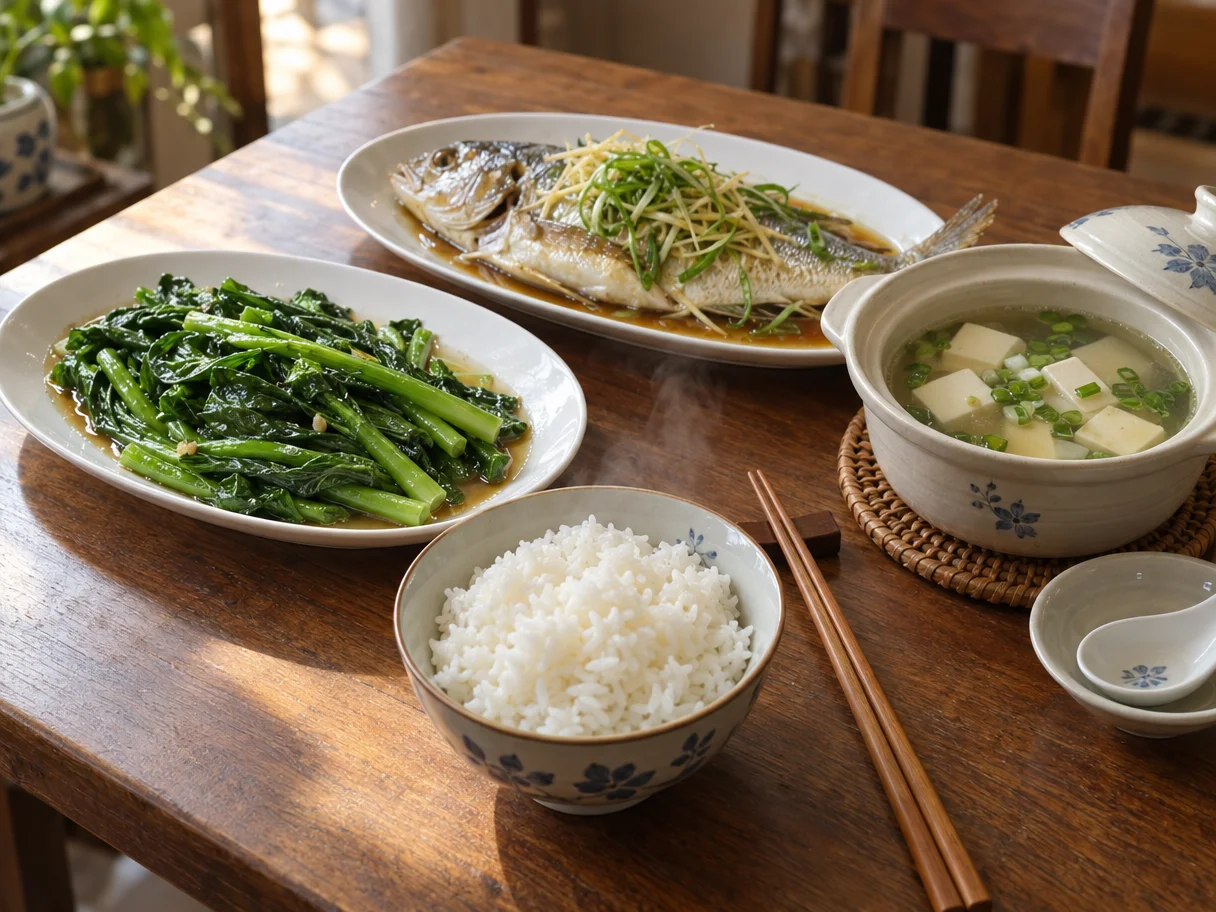
The phrase “the Chinese diet that keeps people thin” sounds like a promise. The research behind it is more specific: some traditional dietary patterns are associated with different weight outcomes. Understanding that pattern means looking at the whole table, not searching for one slimming ingredient.
A Title That Needs Qualifying
China contains many regional cuisines, generations, incomes, and ways of organizing a meal. There is no single Chinese diet and no national body shape. Body weight is entangled with movement, work, sleep, genetics, age, food access, and eating; a bowl of rice cannot explain it on its own.
Researchers use “traditional Chinese diet” as a label for patterns identified in particular groups of people. Those patterns overlap but differ. A 2024 systematic review found 99 studies that addressed the definition. Rice and leafy vegetables appeared in at least 75 percent of them, while wheat featured more often in northern studies and fish, seafood, and pork were prominent in southern ones.
That review is a useful correction to the title. It found broad associations with weight outcomes, but it could not establish standard food quantities or one settled definition. The object is a recurring structure, not a menu with a guaranteed result.
The Traditional Meal Has a Structure
A familiar home meal places a grain beside several shared dishes. In much of southern China, the grain is rice; in northern settings, steamed wheat buns, noodles, or other wheat foods may take its place. The staple matters, but so does the proportion of the table given to everything around it.
Leafy greens and other vegetables commonly appear as cooked dishes rather than as an optional side salad. Bok choy, cabbage, spinach, and many regional greens can be stir-fried, steamed, or added to soup. Tofu, eggs, fish, poultry, or pork may occupy other dishes. The pattern is therefore not rice alone, and it is not necessarily vegetarian.
Research definitions reflect this combination. The 2022 review and meta-analysis described traditional patterns built from grains, vegetables, and protein foods, often including pork. That is a different proposition from crediting white rice, or any other single component, with a particular body outcome.
The useful unit is the table: a staple, several dishes, and the way they are shared. Removing one ingredient from that table changes the question.
Many Small Dishes Change the Pace of a Meal
Shared dining creates variety without requiring every person to cook a separate balanced plate. A family might put a vegetable, a tofu dish, and a small fish or meat dish in the middle, then take portions over the course of the meal. Individual bowls of rice are smaller than the communal spread, and each person can return to the dishes in a different order.
This arrangement makes “small portions” a description of serving style, not a rule for losing weight. A little of several foods is a normal way to experience contrast: something leafy, something savory, something crisp, something soft. Restaurant banquets can be extremely abundant, so shared dining itself says nothing about quantity.
The important distinction is between variety on the table and the idea of a slimming formula. The first is an observable custom. The second turns a social format into a claim it cannot carry. Even the research categories differ: some studies place meat within a traditional pattern, while others identify a separate meat-heavy pattern.
Soup and Home Cooking Belong to the Pattern
Soup is often part of the meal rather than a separate course. It may be a clear broth with vegetables, a longer-cooked family soup, or the liquid around noodles and tofu. Its role varies by region and occasion, but it adds another way for vegetables and other ingredients to appear alongside the staple.
Everyday cooking has also historically relied less on packaged snacks, fast food, and sugar-sweetened drinks than the newer urban patterns studied alongside it. This does not mean traditional kitchens avoid frying, sugar, salt, or preserved foods. Nor does it make every packaged food modern in any meaningful cultural sense. Tofu, noodles, sauces, and pickles all involve skilled processing.
The useful contrast is between a meal assembled mainly from recognizable ingredients and a pattern in which ready-to-eat products do more of the work. It concerns the overall food environment, not a moral ranking of individual foods. Cooking methods also vary enough that researchers warn against treating “traditional” as a precise nutritional measurement.
Recent Decades Changed the Whole Food Environment
China’s rapid economic growth changed much more than restaurant fashion. The studies reviewed here describe a nutrition transition: consumption of cereal grains and legumes in traditional patterns fell in some settings, while meat, edible oils, processed foods, and sweetened drinks became more common. Snacking and fast food also took a larger place in daily life.
At the same time, work and movement changed. More people spent time in offices, commuting through expanding cities, buying food outside the home, or ordering delivery. Supermarkets and refrigeration altered what could be kept and when it could be eaten. These shifts arrived together, which is one reason a single ingredient makes such a poor explanation.
The 2022 meta-analysis did not find a statistically clear overall association for its broad modern or Western category, despite a higher point estimate. That uncertainty matters. The transition describes a changing food environment; it is not proof that every newer food, or every person eating in a newer pattern, moves toward the same weight outcome.
What the Reviews Actually Support
The strongest numbers still need careful language. The 2022 systematic review and meta-analysis included 23 articles. Its abstract reported that a traditional Chinese dietary pattern was associated with lower odds of overweight or obesity, with an odds ratio of 0.69 and a 95 percent confidence interval of 0.57 to 0.84. Most included studies were observational, and the review reported substantial differences in how patterns were defined.
A 2023 longitudinal study adds another qualification. Using data from 4,207 adults in survey waves from 2004 and 2015, it found that patterns labeled “traditional southern” and “traditional northern” had associations in opposite directions for later general and central obesity. A name containing “traditional” did not make two different food patterns equivalent.
So the evidence supports a restrained conclusion. Traditional patterns built around grains, vegetables, and varied shared dishes are worth studying as a whole, and several reviews report associations with weight outcomes. They do not show that adopting a Chinese meal format will make an individual thin. Notice the structure, the regional differences, and the changing surroundings before believing any title that promises a body type.
Sources & Further Reading
- PMC — Exploring the Traditional Chinese Diet and Its Association with Health Status: A Systematic Review
- PMC — Dietary Patterns and Obesity in Chinese Adults: A Systematic Review and Meta-Analysis
- BMC Public Health — Association of Dietary Patterns with General and Central Obesity Among Chinese Adults: A Longitudinal Population-Based Study